Why Abrasion-Resistant Rope Matters at Ski Resorts
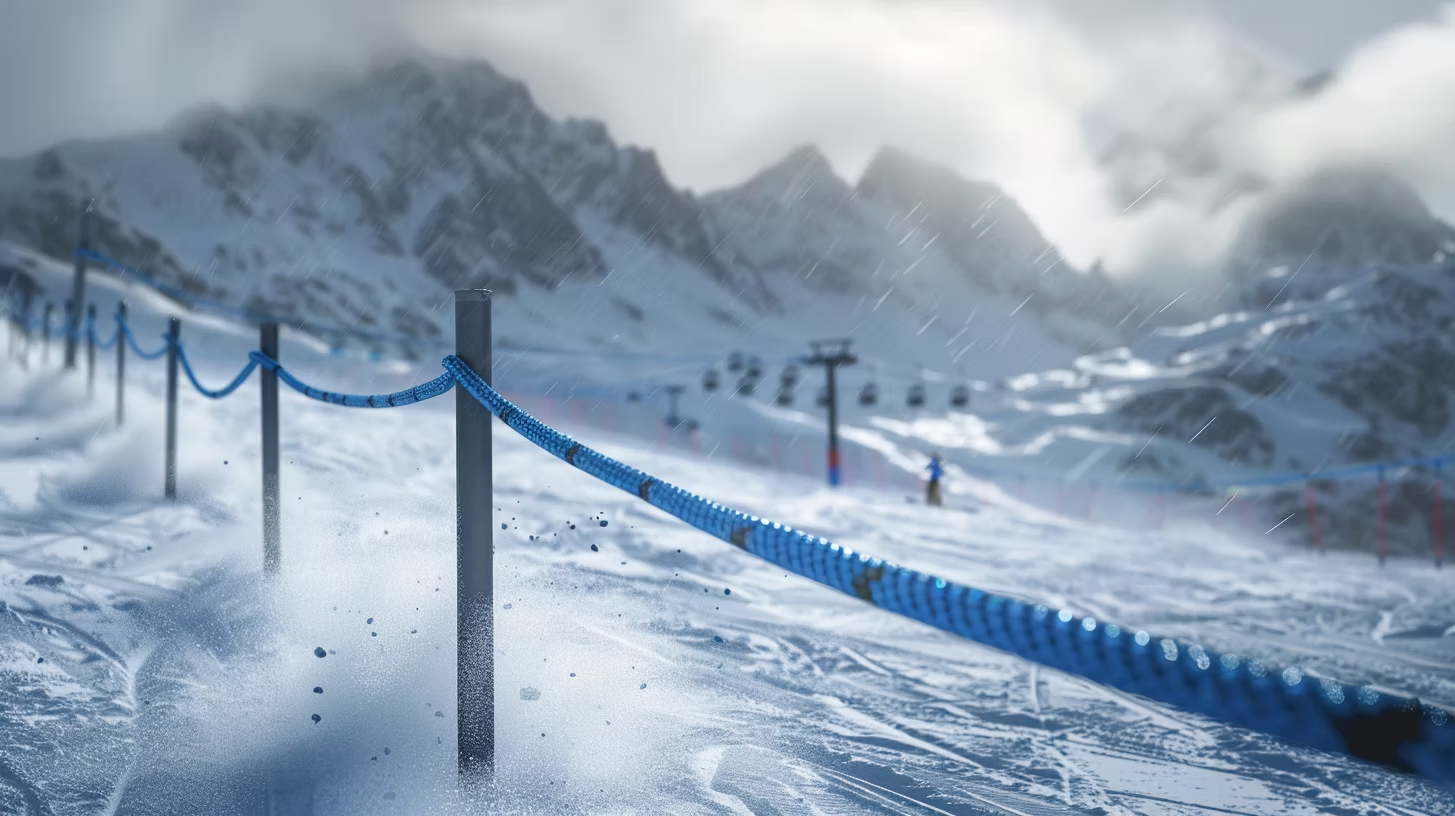
During a peak winter season, a North American ski resort partnered with NeoCorp to address premature wear in a reflective bungee system used to guide skiers toward lift access points. What began as a straightforward color and visibility request evolved into a redesigned rope solution engineered specifically for abrasion-heavy, real-world skier interaction.
Visibility Was Solved. Durability Wasn’t.
The resort’s original requirement was clear: a high-visibility bungee rope that could safely guide skiers while marking restricted areas near lift infrastructure. Reflectivity was essential.
“From what we understood, the rope acted as a visual guideline,” says Anthony Isidoro of NeoCorp. “It helped skiers stay out of no-go zones, especially in low-light or night conditions.”
NeoCorp supplied a reflective blue bungee customized to the resort’s request. An initial order of approximately 3,000 yards was deployed across high-traffic areas. Within weeks of real-world use, the resort identified an issue, not with visibility or elasticity, but with service life. The rope was wearing faster than expected.
Abrasion From Skier Behavior Was the Root Cause
Rather than attributing the issue to product quality, the resort and NeoCorp examined how the rope was actually being used. “The biggest factor turned out to be abrasion,” Isidoro explains. At ski resorts, guests frequently jump lift lines or cut across boundaries, placing their skis directly over the rope and skiing across it. The sharp metal edges on skis repeatedly contact and cut into the cord.
Unlike passive barriers, this bungee was placed in high-interaction zones. Every time a skier crossed it, ski edges introduced aggressive, repeated abrasion. Those micro-cuts compounded quickly, especially in cold conditions where materials stiffen and become less forgiving, accelerating jacket wear and shortening service life.
Over time, abrasion compromised the outer jacket’s ability to protect the bungee's internal structure. Once the jacket began to fail, service life shortened rapidly, increasing replacement frequency, maintenance demands, and operational challenges in high-traffic loading areas. “In these environments, abrasion isn’t cosmetic wear,” Isidoro notes. “It’s a performance issue. Once the jacket goes, everything underneath is exposed.” The challenge wasn’t visibility or elasticity. Those requirements were already being met. The defining issue was durability under real skier behavior — not lab assumptions.
The Solution: Improve the Construction Without Overengineering
NeoCorp evaluated multiple material paths, including high-performance fibers such as aramids. While aramids offer strong abrasion resistance, they perform poorly under prolonged UV exposure — making them unsuitable for high-altitude, outdoor ski environments.
Instead, NeoCorp selected UHMWPE (Ultra-High Molecular Weight Polyethylene) as a better fit for the application, providing improved abrasion resistance along with stronger UV durability for sustained outdoor use.
Beyond material selection, NeoCorp redesigned the jacket construction to better withstand repeated ski-edge contact. This upgrade significantly increased material cost, but it directly addressed the real failure mode observed in the field.
The revised construction:
Withstood repeated ski-edge abrasion
Retained integrated reflective yarn
Preserved bungee performance
Extended service life in high-interaction zones
“There’s always a balance,” Isidoro says. “You want durability, but you don’t want customers paying for performance they don’t need.”
Built for Real Use
Prototype samples were produced and sent to the resort for field testing. Field testing confirmed the revised design performed as intended. “The feedback was simple,” Isidoro recalls. “They liked it, it lasted longer, and it solved the problem.” With testing complete, NeoCorp moved forward with yarn procurement and production planning for the updated construction. The resort gained a longer-lasting safety solution without redesigning infrastructure or increasing operational complexity.
Results: The Abrasion-Resistant Rope Extended Service Life in a High-Interaction Environment
While lifespan targets vary by installation, the redesigned rope delivered:
Improved abrasion resistance in skier-heavy zones
Maintained reflectivity for low-light and snow conditions
Reduced premature replacement cycles
Continued alignment with the resort’s safety objectives
Most importantly, the solution aligned with how the environment actually behaved, not how it was expected to behave on paper.
Key Takeaway: Rope Doesn’t Fail. Assumptions Do.
According to NeoCorp, this case reflects a broader lesson across outdoor sports venues.
“Most issues we see aren’t about strength ratings,” Isidoro explains. “They’re about abrasion, interaction, and environment.”
By treating abrasion-resistant rope as an engineered component rather than a commodity, the resort moved from replacement to resolution. “The moment customers start telling us how a product is really being used,” Isidoro says, “that’s when the best solutions show up.”