How A Filtration System Manufacturer Eliminated Leaks with CGR Filter Ropes
In industrial filtration systems, the smallest components often carry the greatest responsibility. That was the reality for an industrial filtration system manufacturer serving municipal wastewater treatment and food processing facilities, where reliability isn’t optional, and failure can ripple far beyond the factory floor.
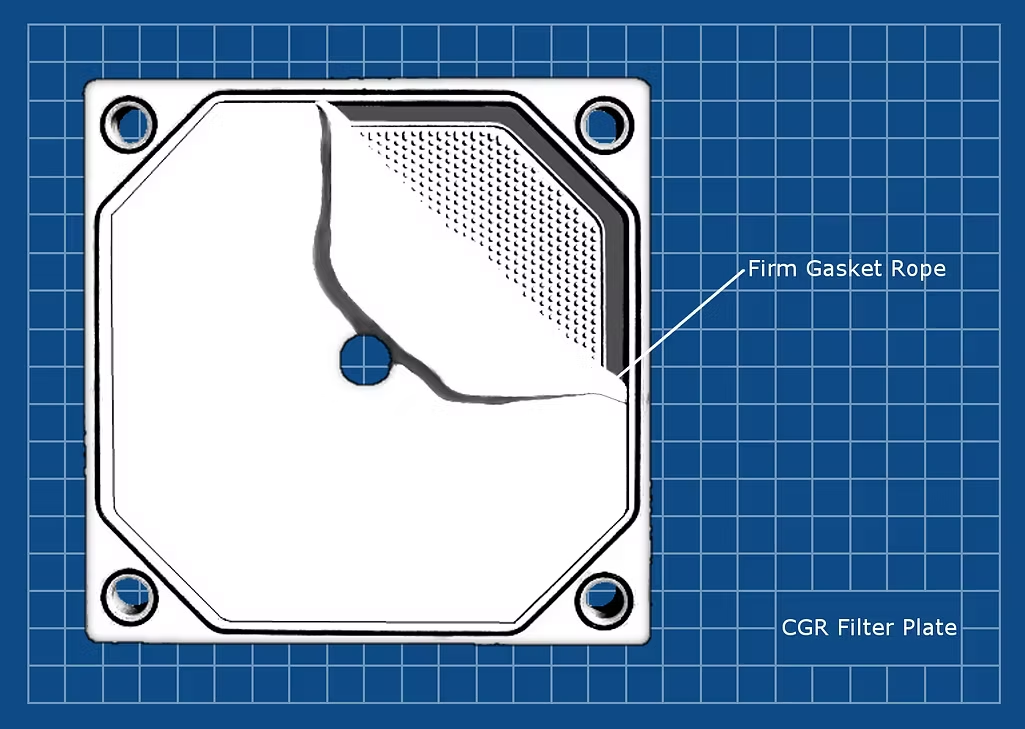
At the center of their challenge was a deceptively simple part: a gasket cord used in caulked, gasketed, and recessed-chamber (CGR) filter plate systems. Once installed, the cord is compressed into a recessed groove, acting as a seal to hold the filter media firmly in place. If it performs perfectly, the system runs as intended. If it doesn’t, the consequences can include leakage, unplanned downtime, or compromised filtration.
For this filtration system manufacturer, “close enough” was never going to be good enough.
A Requirement That Left No Room for Error
The filtration systems were designed to be fully recyclable, which meant every component, including the gasket cord, had to be made from polypropylene. At the same time, the cord’s density had to remain extremely consistent so it would compress evenly and maintain a reliable seal across dozens, or even hundreds, of filter plates assembled.
Over time, subtle variation began to appear. While these shifts were small enough to pass traditional checks, they introduced uncertainty once the systems were deployed in regulated environments where performance consistency is closely tied to public safety, compliance, and operational continuity.
What appeared to be a minor component had quietly become a critical performance variable.
Looking Beyond a Standard Product
Rather than sourcing another off-the-shelf solution, the filtration system manufacturer looked for a partner who would step back and examine how the gasket cord actually functioned inside the CGR filter press system.
NeoCorp approached the challenge by focusing on real-world performance, not just material specifications. The objective was clear but demanding: ensure that every length of cord behaved predictably once compressed into the recessed chamber—run after run, order after order.
That meant rethinking not just the cord itself, but how compression, elongation, and density were controlled throughout manufacturing.
Turning Insight into Control
NeoCorp worked closely with the filtration system manufacturer to develop a high-density polypropylene gasket cord engineered specifically for CGR filter plate systems. Central to the solution was NeoCorp’s patented Interlace® technology, which controls compression and elongation under load. This construction allowed the cord to resist deformation while maintaining stable, predictable sealing performance once seated in the recessed chamber.
Just as important was how consistency was verified. Instead of relying on occasional spot checks, NeoCorp implemented continuous, in-process monitoring during production. Density and compression data were tracked over time, revealing subtle patterns that occur during extended manufacturing runs.
This insight allowed NeoCorp to make proactive adjustments before the cord could fall out of tolerance. Quality control shifted from reactive inspection to intentional, predictive control.
Results That Built Long-Term Confidence
Since implementing this approach, the gasket cord has been in continuous production for more than five years without a single density-related failure. There have been no returns, no leakage issues, and no field performance concerns tied to the cord.
For the filtration system manufacturer, this translated into reduced inspection burden, fewer unknowns, and long-term confidence that every system would perform as designed—whether installed in a municipal wastewater facility or a food processing operation.
Consistency stopped being an assumption and became a controlled outcome.
More Than a Filter Cordage Supplier
This case reflects how NeoCorp partners with industrial filtration system manufacturers when the margin for error is small, and the consequences of failure extend well beyond the equipment itself.
By combining application-specific engineering, patented construction methods, and disciplined quality control, NeoCorp delivers filtration cord solutions that perform reliably not just at qualification, but over years of production in regulated environments.
Built for CGR Filter Plate Systems
The solution featured in this case study is NeoCorp’s CGR Filter Cord, a high-density gasket cord engineered for caulked, gasketed, and recessed-chamber filter press systems where compression stability, density control, and long-term consistency are critical.